Every use case starts the build again.
Connect sources. Map and clean. Define metrics. Build services and interfaces. Repeating the data-to-app work slows the next operational idea.
Reuse a configuration-driven path to the product
Turn enterprise data into operational applications with AI-assisted definition, full-stack generation, and a path to local edge delivery. Your team shapes the product and reviews what runs.
Built to work with
your data stack.
TWO GAPS. ONE CONNECTED LIFECYCLE.
For data and platform teams supporting maintenance, readiness, and remote operations, the last mile is more than another dashboard. It’s a usable product, in the environment that needs it.
Connect sources. Map and clean. Define metrics. Build services and interfaces. Repeating the data-to-app work slows the next operational idea.
A cloud-only experience stops where connectivity stops. Deployed maintenance, remote sites, and field teams need selected data and services close at hand.
THE PLATFORM
Connect the data foundation, product definition, and application build in one lifecycle. Review recommendations, inspect the output, and shape what comes next.
Turn real source structure into recommendations for KPIs, personas, and dashboards. Review the mappings. See what’s missing. Shape the product before it’s built.
Generate the backend, frontend, migrations, and deployment artifacts. Download the code and let your engineers take it forward.
├backend Spring Boot
├frontend React + TypeScript
├migrations Database
└deploy Docker · Helm · CI
Configurable compile and Docker checks, with visible repair outcomes. Know what passed and what still needs attention.
Sync with idempotent upserts, protection for user-edited records, and audit counts that make changes visible.
THE PRODUCT, IN CONTEXT
Readiness, maintenance, and parts in a persona-focused experience. Connect the headline metric to the work—and the data—behind it.
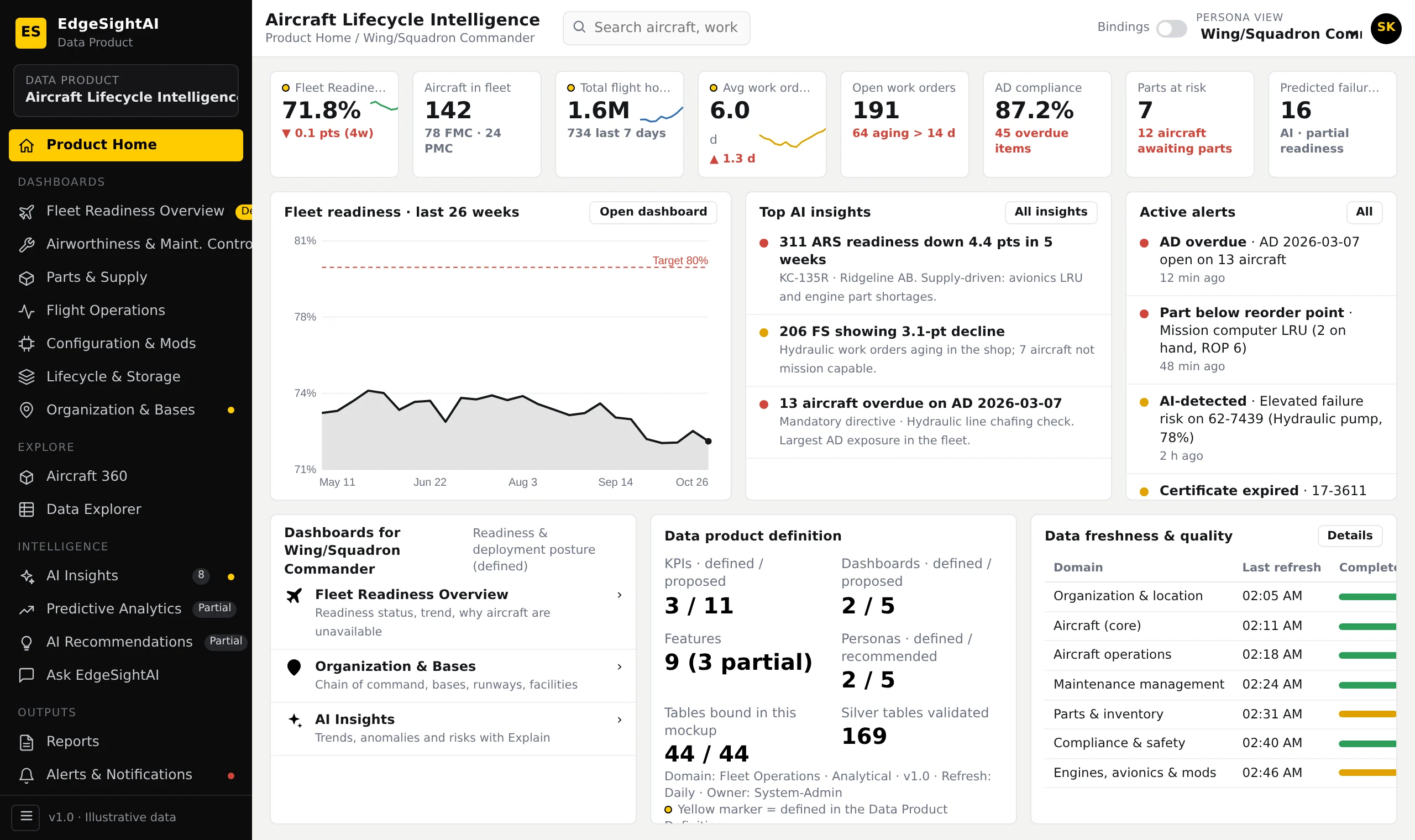
Bring readiness, open maintenance, and parts dependencies into the same decision context.
The illustrated AI experience explains trends and supports product-scoped Q&A. Validate answers and data boundaries in your pilot.
Review source mappings, freshness, and definition gaps before relying on a feature or recommendation.
AUTHOR. REVIEW. DELIVER.
Use natural language to shape the need. Review AI recommendations against your schema. Generate, verify, and package a product your team can inspect.
Connect PostgreSQL, MySQL, SQL Server, or Amazon S3. Bring your source data into a Databricks-orchestrated Bronze, Silver, and Gold workflow.
source: PostgreSQLpipeline: Bronze → Silver → Goldschema: inspected from SilverBUILT AROUND THE WORK
Start with the decision your team needs to make. Build the data experience around it.
A CLEARER OPERATIONAL PICTURE
Bring asset status, maintenance history, and open work orders into a product built around readiness decisions. Explore the constraints behind availability and give each role a focused view of the work.
Illustrative product concept. Sample data, not customer results.
ENGINEERING CONTROL, BUILT IN
Generated shouldn’t mean opaque. Keep the code, delivery path, and operating controls within reach of the people responsible for them.
A closer look at the stackDownload the generated application. Review the implementation, extend it, and make it part of your engineering workflow.
Spring Boot / React / TypeScriptCloud and edge paths, with deployment artifacts your team can configure for the target environment.
AWS ECS + ECR / OVH / KubeEdgePlatform roles, module-level permissions, and audit export help teams manage who can do what.
Roles / Permissions / Audit exportIdempotent synchronization protects user-edited records and reports counts for a clearer change history.
Edit-aware sync / Auditable outcomesDESIGNED FOR THE LAST MILE
Designed for packaged workloads at the edge. Prepare in the connected enterprise, then bring selected application services and data to the environment that needs them.
Databricks + approved
AI service / provider
Packaged application & API
Data, queries & dashboard
The reported proof-of-concept in an AWS-simulated KubeEdge environment showed packaged APIs, the application, queries, and dashboards available after the enterprise link was removed. Your pilot validates local application and data availability under the disconnection conditions your team actually faces.
Local scope depends on packaged data, services, models, and device resources. Cloud AI, fresh enterprise data, and new cloud deployments or updates need connectivity. Local AI needs a configured model and sufficient resources.
A FOCUSED FIRST STEP
Bring a real decision, representative data, and a destination. Shape a pilot that gives your data and operational teams evidence they can evaluate.
Pick one operational workflow and the representative sources it needs.
Agree acceptance criteria and a comparable baseline before the work begins.
Review the generated product in the target environment, including hardware and disconnected behavior where relevant.
Measure delivery effort, quality, reuse, and offline continuity. Use the findings to shape the next product.
Delivery time · Manual effort · Quality · Reuse · Offline continuity
Agree the baseline and success criteria before your pilot begins.A FEW GOOD QUESTIONS
Thinking about your own data?
That’s a good place to start.
A purpose-built application that makes enterprise data usable for a specific audience or operational task. It can bring together APIs, data views, dashboards, and AI-assisted exploration, backed by a generated Spring Boot backend and React/TypeScript frontend.
EdgeSightAI uses the actual Silver schema to inform recommendations for KPIs, personas, dashboards, and source mappings. It surfaces missing data and readiness gaps. Your team reviews and edits the product definition before generation.
Source connections include PostgreSQL, MySQL, SQL Server, and Amazon S3, with Databricks orchestration for Bronze, Silver, and Gold data layers. Generated application artifacts include Spring Boot, React, TypeScript, database migrations, Docker, Helm, and GitHub Actions.
Yes. Application code can be downloaded and inspected by your team. EdgeSightAI also provides configurable compile and Docker verification, with visible check and repair outcomes. Generated output still needs your engineering review, configuration, and deployment validation.
Packaged application services and local data are the focus of KubeEdge delivery. A reported AWS-simulated proof-of-concept showed local APIs, application views, queries, and dashboards available after the enterprise link was removed. Your pilot validates the intended hardware and disconnection conditions. Cloud AI, fresh enterprise data, and new cloud deployments or updates need connectivity. Local AI depends on configured models and device resources; automatic sync-back is not assumed.
Platform controls include roles, module permissions, and audit export. Data synchronization uses idempotent upserts, protects user-edited records, and reports audit counts so teams can understand what changed.
Start with one operational decision, representative sources, and the environment where the product will run. Together, define acceptance criteria and a baseline, then evaluate effort, quality, reuse, and any required disconnected behavior. Use ‘Scope a pilot’ to share your workflow, data, and target environment.
The end-to-end lifecycle and simulated edge deployment have been demonstrated in laboratory environments. A pilot is the next step to validate customer data, intended hardware, security boundaries, and operational acceptance. Production hardening, repeatable packaging, and deployment-specific validation remain part of the path to production.
FROM YOUR DATA. FOR YOUR OPERATIONS.
One workflow. A clear acceptance bar.
Let’s scope what comes next.